

 Did you know “Mystery”, the genre we all know and love, wasn’t a genre in the early 1800s?
There was romance (which did not mean what it does today) and horror (which does mean what it does today), history, and biographies, but no Mystery. In addition to writing full-length mysteries, including my current release Guilty by Association,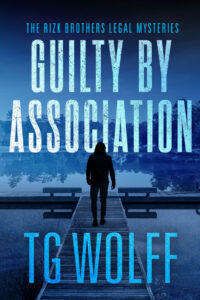 I am an avid mystery reader and co-creator of the podcast Mysteries to Die For. For Seasons 2 and 3, I went back into the public domain to find the very earliest mysteries. It was more of an exercise than I expected because—say it with me—mystery wasn’t a genre.
Many if not all horror stories have elements of mystery in them. Not to be too general, but horror storytellers documented events (Dr. Jeckyll and Mr. Hyde) or tried to survive them (Dracula), rather than solve them. Similar with Romance.
So with a quick flip, the narrator becomes a detective and the story a mystery.
One of the first mysteries was Mademoiselle de Scuderi by E.T.A Hoffman, published in 1819. Our detective and storyteller is a 73-year old woman, perhaps the first cozy mystery? Fascinating that at that time, Hoffman chose a female to be his lead. There are many fine and early mysteries penned by the French. I wish I could read them in the native language but am glad to have the English translations available.
In 1841, Edgar Allen Poe published his short story The Murders in the Rue Morgue. Set in Paris, his detective, C. Auguste Dupin, was brought in for one purpose: to solve the mystery. And not just any mystery but what would turn into a classic sub-genre, the locked door mystery.
The first Sherlock Holmes series, A Study in Scarlet, was published 46 years later in 1887. Holmes became so beloved that many think he was the first—he was far from it. Read Dupin and you will see the roots of Holmes. Do you know the names LeCoq, Hewitt, Thorndyke, Rouletabille?
Mark Twain put his pen to the task in Tom Sawyer, Detective (1896) with the story told by Huck Finn as Tom Sawyer detects to save an innocent man from the gallows. Written in Huck’s freeform style of speaking, this is one of my favs. Possibly it was the first legal mystery? The first to combine mystery and humor? Example, acting as the attorney for the defense, Tom Sawyer continually mixes up words – like calling the Prosecution the Prostitution. LMAO!
Anna Katherine Green’s detective Police Inspector Ebenezer Gryce first led the case of The Strange Disappearance in 1880. Set in New York City, it’s a snapshot in time as well as a fine mystery. Sometimes referred to as a mother of mystery, Green can be overlooked as she stayed with an older Victorian depiction of society while her peers changed more with the times. Understanding this makes the study even more interesting.
The Haunted and the Haunters by Edward Bulwer-Lytton is a story that is so badly flawed it’s cringeworthy. If you read it, brace yourself. Maybe treat it like a farce. Bulwer-Lytton created the worse opening line ever, which turned into a contest. You know the line—at least part of it—can you guess?
Last chance before the answer….
“It was a dark and stormy night; the rain fell in torrents—except at occasional intervals, when it was checked by a violent gust of wind which swept up the streets (for it is in London that our scene lies), rattling along the housetops, and fiercely agitating the scanty flame of the lamps that struggled against the darkness." From PAUL CLIFFORD by Edward Bulwer-Lytton
Finally, a special place is reserved for the stories of Allan Pinkerton, the Scottish immigrant who founded the legendary Pinkerton Detective Agency. In short story form, he retold actual cases, including the solution and tactics his detectives used. Pinkerton’s stories may very well be the first True Crime. The Somnambulist and the Detective was published in 1875 with the case taking place 19 years prior in 1856.
Answering the question that started this blog … No, once a mystery was not always a mystery, but these grandfathers and grandmothers of the genre with love created the troupes and sub-genres we flock to today. Well written and well crafted (except for Bulwer-Lytton), these masters still deserve a place on every TBR.
Happy reading, detectives!
TG Wolff has never been able resist a good puzzle. With an engineer’s mind for logic and a lifelong love of mysteries, she crafts whodunnit stories that challenge readers to outsmart her detective. Her books are filled with quirky characters, red herrings, and—because she firmly believes solving (fictional) murders should be fun—a healthy dose of humor.
TG earned both her Bachelor’s and Master’s degrees in civil engineering, learning early to see every problem as a mystery, and each solution as the answer the result of asking the right questions. That same curiosity drives her fiction, where nothing is ever accidental and every detail counts.
When she’s not plotting fictional crimes, TG is a mystery reader and reviewer, and the co-creator / co-host of the whodunnit mystery podcast Mysteries to Die For.
Goodreads: https://www.goodreads.com/author/show/19815472.T_G_Wolff
Bookbub: @TG_Wolff
Facebook: https://www.facebook.com/tina.wolff.125
Instagram: https://www.instagram.com/tg_wolff/
LinkedIn: https://www.linkedin.com/in/tina-
Loved learning that the mystery wasn’t always a mystery and about the origin of It’s Was a Dark and Stormy Night. Thanks for blogging today.
Loved this crash course in how the mystery evolved. Now on to TG Wolff’s….
There’s also Wilkie Collins’ The Moonstone, early police procedural, 1868, and the unfinished Mystery of Edwin Drood, by Dickens, 1870.
Great history on mysteries. I love that the first fictional detective of a cozy mystery was a woman.